Of all the major AI answer engines, Perplexity is the one where optimization efforts show up fastest and most visibly. It is also the one that behaves least like the others. Strategies that work well for ChatGPT or Gemini often underperform on Perplexity, and brands that treat all AI platforms as a single channel routinely find themselves visible in one and absent from another.
This post is a deep dive on what makes Perplexity unique, why it deserves its own strategy, and what actually moves the needle for brands that want to be cited.
Why Perplexity is structurally different
Most AI assistants generate answers primarily from their training data, reaching for live web retrieval when a query demands current information. Perplexity inverts that model. It is built around real-time retrieval first: every answer starts with a live search of the web, and the response is synthesized from the sources it fetches in that moment. The industry term for this is Retrieval-Augmented Generation, and Perplexity is the most retrieval-heavy of the major platforms.
This architectural difference has three practical consequences for brands.
First, citations are the product. Perplexity displays its sources prominently in every answer, with clickable links. Where ChatGPT may mention a brand without attribution, Perplexity shows users exactly where each claim came from. That makes a citation on Perplexity both a visibility win and a trackable referral channel. Users click through, and those visits show up in analytics with clear referral data.
Second, current relevance beats cumulative authority. Traditional SEO rewards domains that have accumulated authority over years. Perplexity's retrieval pipeline evaluates whether a specific page is the best available resource for a specific query right now. A well-structured page published last month can outrank a decade-old authority site if it answers the query more directly and more freshly. This is a genuine opening for smaller and newer brands that cannot win a backlink war against entrenched competitors.
Third, the citation pool is distinctive. Analysis across AI platforms consistently finds that Perplexity draws from a different mix of sources than its peers. It leans heavily on community-driven platforms, with Reddit playing an outsized role, and on recently published content from industry publications. Notably, research tracking citation behavior across engines has found Perplexity rarely, if ever, cites Wikipedia, which is a staple source for ChatGPT. The overlap in citations between Perplexity and ChatGPT for identical queries is low, with studies finding the two platforms cite different sources roughly 89% of the time.
The signals that drive Perplexity citations
Across the research and our own client work, four signals explain most of the variance in whether a brand gets cited on Perplexity.
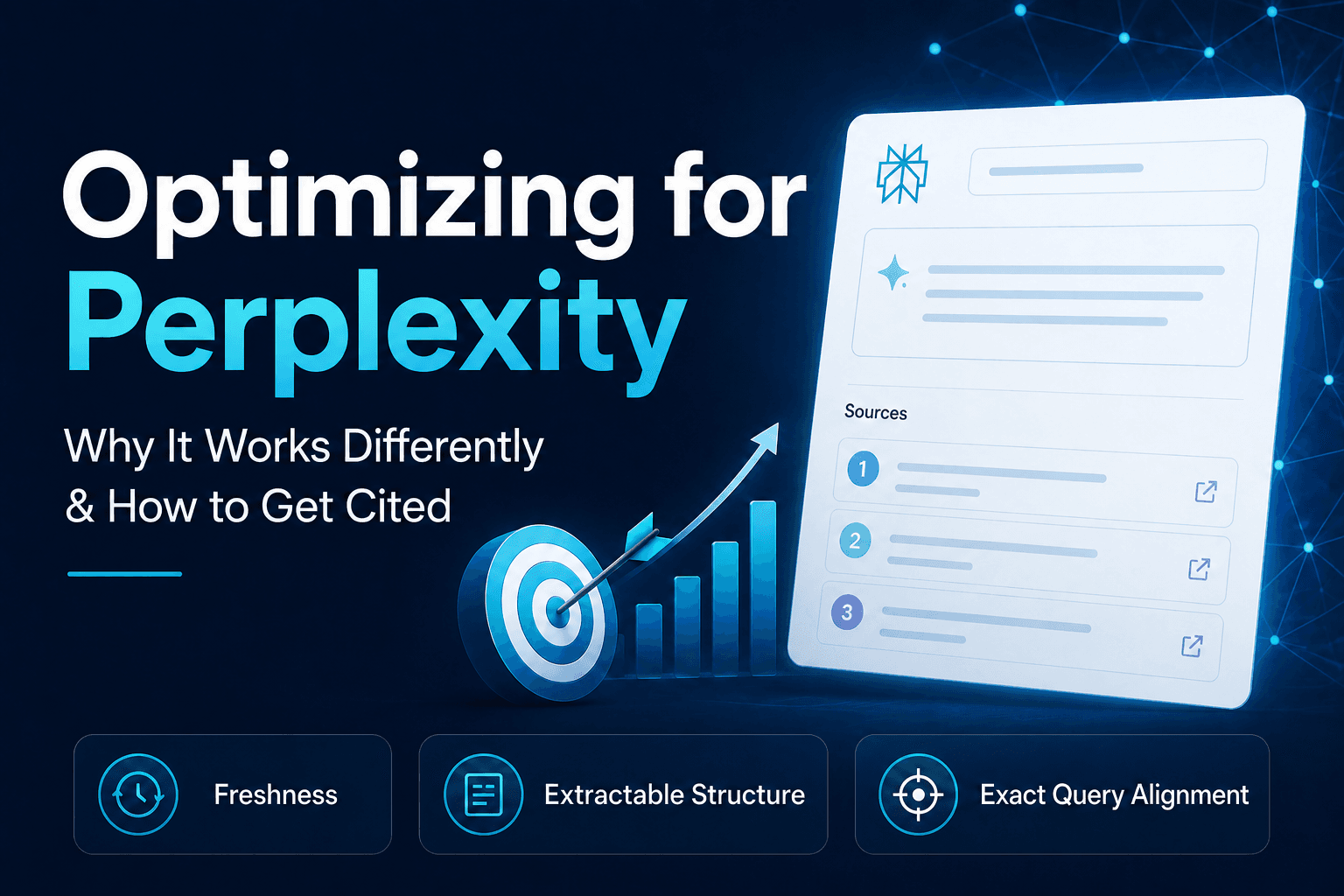
Crawler access. Perplexity retrieves content through its own crawler, PerplexityBot. If your site blocks it in robots.txt, you are invisible to Perplexity's retrieval layer no matter how strong your content is. This sounds basic, but it is one of the most common reasons brands with otherwise solid AEO fundamentals are absent from Perplexity specifically. Checking crawler access is the first diagnostic step, and it takes five minutes.
Freshness. Perplexity weights recency more heavily than any other major platform. Recently published and recently updated content is dramatically more likely to be retrieved and cited. For brands, this changes the content calculus: a publishing cadence with regular updates to existing pages outperforms a static library of comprehensive but aging content. Date stamps, updated statistics, and visible revision signals all support this.
Extractable structure. Perplexity's synthesis process favors content it can parse and extract quickly. Answer-first formatting, where the direct answer to a question appears in the opening paragraph rather than after a long narrative windup, is consistently cited more. Clear headings that mirror how users actually phrase questions, comparison tables, bulleted specifications, and FAQ sections all improve extractability. Narrative-style pages that bury the answer perform poorly regardless of quality.
Exact query alignment. This is where Perplexity diverges most sharply from ChatGPT. ChatGPT tolerates partial and semantic matches between a query and a page. Perplexity shows a measurable preference for pages whose titles, headings, and metadata mirror the exact wording of the query. Research on Perplexity ranking factors found match score correlates meaningfully with citation position, with top-cited brands scoring notably higher on exact phrasing alignment. Creating pages that target the literal prompt language your buyers use, such as "best [category] for [use case]," is one of the highest-leverage tactical moves available.
The off-site layer: where Perplexity looks beyond your website
Optimizing your own site is necessary but not sufficient. Perplexity's citation pool is heavily weighted toward third-party surfaces, and brands that ignore the off-site layer leave significant visibility on the table.
Reddit deserves particular attention. Community discussion threads are among the most frequently cited source types on Perplexity, and brands with genuine, organic presence in relevant subreddits appear more often than their domain metrics alone would predict. This does not mean astroturfing, which communities detect and punish. It means legitimate participation, being genuinely discussed by real users, and having accurate information about your brand present in the threads where your category gets debated.
Industry publications and review platforms matter for the same reason. When Perplexity retrieves sources for a commercial query, credible third-party roundups, comparison articles, and review aggregators are heavily represented. Earning inclusion in those pieces functions like link building did in traditional SEO, with a twist: the goal is not the link equity but the presence of your brand in the specific pages Perplexity retrieves for your target queries.
A practical way to operationalize this: identify which sources Perplexity is actually citing for the queries that matter to your brand, then work to be present on those specific pages and platforms. The citation trail is public and visible in every answer, which makes this kind of source mapping far more tractable on Perplexity than on platforms that hide their retrieval.
Why Perplexity is worth the dedicated effort
A reasonable question is whether a platform smaller than ChatGPT deserves its own optimization strategy. The evidence says yes, for three reasons.
The audience is high-intent. Perplexity's user base skews toward researchers, professionals, and buyers doing deliberate evaluation. AI-referred visitors across platforms convert at multiples of traditional organic traffic, and Perplexity's citation-forward design produces qualified click-throughs from users who chose your source deliberately.
The feedback loop is fast and visible. Because Perplexity retrieves in real time, optimization changes can show up in citations within weeks rather than waiting on model retraining cycles. And because every citation is displayed, measurement is more direct than on any other platform. You can see exactly what is being cited, run your priority queries, and track movement over time.
The competitive field is still thin. Most brands are not yet optimizing for Perplexity specifically. The brands that build presence now, while the platform's usage is growing and the category norms are still forming, are establishing positions that will be harder to take later.
How Sentient AEO approaches Perplexity
Perplexity is one of the three core platforms covered in our AI Visibility Audit, alongside ChatGPT and Google AI Overviews, with additional coverage available for Gemini, Google AI Mode, Grok, and Claude. The audit runs buyer-intent prompt testing to establish where a brand currently stands: which queries surface the brand, how it is described, which competitors appear instead, and critically for Perplexity, which specific sources are driving the citations in the category.
That source-level view shapes the optimization work that follows. Because Perplexity shows its retrieval trail, we can identify the exact pages and platforms winning citations for priority queries and build a targeted plan: fixing crawler access if it is blocked, restructuring priority pages for extractability and query alignment, refreshing content on a cadence that matches Perplexity's recency weighting, and closing the third-party gaps where competitors are cited and the brand is not.
From there, ongoing tracking captures how citations shift over time as the work compounds. Perplexity's fast feedback loop makes it one of the clearest places to demonstrate AEO progress, which is part of why we consider it essential coverage rather than an afterthought.
Sentient AEO helps brands build and measure AI search visibility across ChatGPT, Google AI Overviews, and Perplexity, with additional coverage for Gemini, Google AI Mode, Grok, and Claude. If you're trying to understand where your brand stands in the AI answer layer, get in touch with us for an AEO audit: [email protected]
Citations
-
Perplexity's RAG architecture prioritizes current relevance, structure, and freshness over cumulative domain authority — Stackmatix, Perplexity Brand Visibility: How to Get Cited in AI-Powered Search: https://www.stackmatix.com/blog/perplexity-brand-visibility-strategy
-
Four core Perplexity citation signals: PerplexityBot crawler access, recency weighting, authority signals, extractable content density — SolCrys, Optimize for Perplexity AI: https://solcrys.com/optimize-for-perplexity/
-
Perplexity prefers exact query-phrase alignment in titles and headings; match score correlated with citation position — Analyze AI, Perplexity AI Ranking Guide: https://www.tryanalyze.ai/blog/how-to-rank-on-perplexity
-
Perplexity rarely cites Wikipedia, unlike ChatGPT; engines diverge significantly in source preference — Analyze AI, Perplexity AI Ranking Guide: https://www.tryanalyze.ai/blog/how-to-rank-on-perplexity
-
89% of citations differ between ChatGPT and Perplexity for identical queries — Exposure Ninja, AI Search Statistics: https://exposureninja.com/blog/ai-search-statistics/
-
Reddit among the most frequently cited source types on Perplexity; third-party platforms accelerate visibility faster than on-site content alone — Simaia, 8 Best Methods to Get Your Brand Cited by Perplexity AI: https://simaia.co/resources/8-best-methods-to-get-your-brand-cited-by-perplexity-ai-in-your-industry-in-2026
-
Answer-first structured content is far more likely to be extracted and cited than narrative-style pages — Simaia, 8 Best Methods to Get Your Brand Cited by Perplexity AI: https://simaia.co/resources/8-best-methods-to-get-your-brand-cited-by-perplexity-ai-in-your-industry-in-2026
-
AI referral traffic converts at multiples of organic; AI visitors spend 67.7% more time on-site — ZipTie, How to Optimize Content for Perplexity AI: https://ziptie.dev/blog/how-to-optimize-content-for-perplexity-ai/
-
Perplexity referral traffic share grew 25% from January to April 2025 — ZipTie, How to Optimize Content for Perplexity AI: https://ziptie.dev/blog/how-to-optimize-content-for-perplexity-ai/