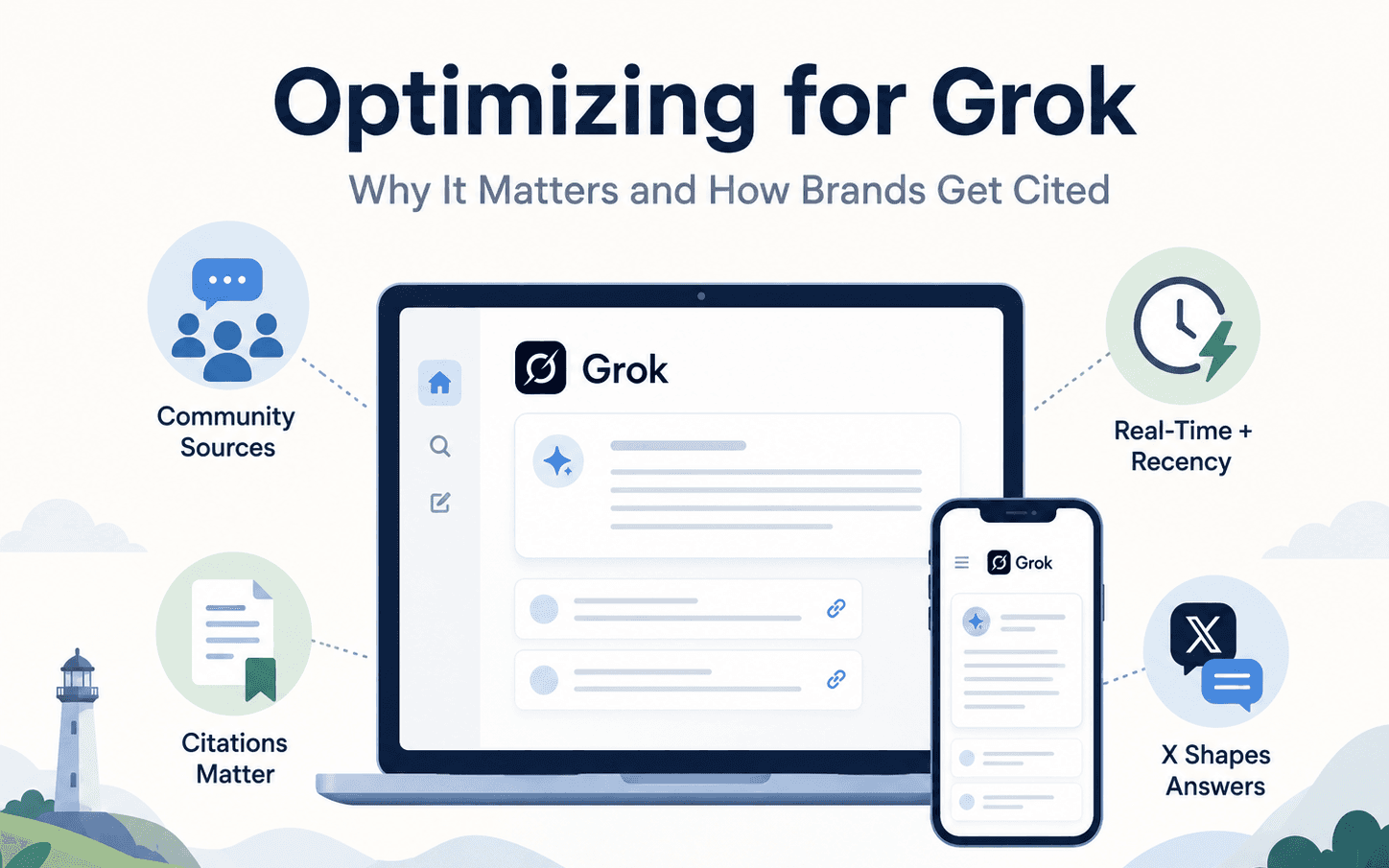
Grok is the AI platform most marketing teams have decided to skip, and the reasoning is usually the same: it does not send us traffic.
That reasoning is correct on the facts and wrong on the conclusion.
According to SpaceX's May 2026 S-1 filing, 117 million people use Grok's features every month, out of X's 550 million monthly active users. Reuters, citing Apptopia data, put Grok at 17.8% of the U.S. chatbot market in January 2026, third behind ChatGPT at 52.9% and Gemini at 29.4%. That share has since settled into the low teens, but the audience is real and it is enormous.
And it sends almost nothing back. One 2026 analysis of B2B referral panels found Grok's outbound referral volume to be effectively zero, while its in-session depth was the highest of any major engine at 16.89 pages and nearly 12 minutes per visit. Grok is not behaving like a search interface. It is behaving like a destination.
This is the part worth sitting with. Over a hundred million people are forming opinions about brands inside a system that leaves no trace in your analytics. If your AI visibility strategy is scoped by what shows up in GA4, Grok is a blind spot by design.
Who is actually using Grok
Grok's user base is the most demographically skewed of any major chatbot. Similarweb puts it at roughly 67% male and 33% female, with 25 to 34 year olds as the largest age cohort. The United States accounts for a little over a fifth of traffic, followed by India and Brazil.
That skew matters for prioritization. For categories where the buying audience concentrates in that demographic, Grok is closer to a primary surface than a secondary one. For categories where it does not, Grok is a reputation risk to monitor rather than a channel to invest against. The same platform warrants different levels of attention depending on who is actually asking.
What Grok actually cites
The most useful public data on this comes from Ahrefs, which tracked every domain Grok cited across more than 1.9 million U.S. queries in June 2026 and ranked them by mention share.
The top of the list is dominated by user-generated content:
- Reddit: 16.3%
- YouTube: 15.1%
- Facebook: 13.9%
- Instagram: 5.9%
- Quora: 5.5%
- Amazon: 5.0%
- TikTok: 4.8%
- Wikipedia: 3.4%
Seven of the eight most-cited domains are platforms where the content is written by users rather than brands. This is a meaningfully different citation pool than ChatGPT or Google AI Overviews, and it points to a different set of priorities.
The finding that surprises most teams
x.com itself ranks twelfth, at 1.4% of mention share.
That number tends to stop people, because the common assumption is that optimizing for Grok means posting more on X. The data does not support that as a standalone strategy.
The explanation is structural rather than contradictory. X content reaches Grok through xAI's internal platform integration, not through web crawling, so it shapes the answer without necessarily appearing in the visible citation slate. The firehose is an input to Grok's reasoning. It is not where most of Grok's attributable sources come from.
Both things are true at once: X presence influences what Grok says about you, and X presence alone will not get you cited.
The three inputs behind a Grok answer
Understanding Grok's behavior is easier when you separate its inputs.
The X firehose. Real-time public posts, replies, and engagement patterns, delivered through platform integration rather than crawling. This is the input no other major answer engine has.
Web retrieval. xAI's crawlers fetch pages to ground answers, and DeepSearch runs multi-step agentic crawls that return numbered citations.
Model priors. What the underlying model already learned about your brand and category during training, which is where consensus and long-running reputation live.
The practical consequence is that Grok is the most cadence-sensitive engine in the market. On time-sensitive queries it favors sources published or discussed within hours. A brand publishing weekly stays inside that recency window. A brand that last updated its site a quarter ago falls out of it.
The technical layer behaves differently here
This is where the standard AEO checklist breaks down.
You probably cannot verify that Grok can reach you
xAI documents crawler user agents including GrokBot, xAI-Grok, and Grok-DeepSearch. Multiple independent traffic analyses report that these tokens rarely or never appear in real server logs. Grok's retrieval traffic has been observed using rotating residential IPs and spoofed Safari and Chrome user agents, which makes it functionally indistinguishable from a human visitor at the user-agent layer.
For most AI platforms, the technical fix is simple: check robots.txt, allow the bot, confirm crawl activity in your logs. For Grok, none of those three steps reliably works.
The real risk is not robots.txt. It is your WAF. Default bot-management profiles at Cloudflare, Akamai, and Fastly frequently challenge or block traffic that looks like an unidentified scraper, which is exactly what Grok's fetches look like. A brand can be blocking Grok at the firewall layer with no robots.txt rule in place and no way to see it happening.
You cannot opt out of the social layer
No server configuration touches the X firehose. Posts about your brand, accurate or not, flow into Grok's context regardless of your crawl policy.
That asymmetry argues strongly for keeping web retrieval open. If social conversation is going to shape Grok's picture of your brand anyway, your own pages should be in the room as the authoritative counterweight.
What actually moves the needle
Presence on the platforms Grok leans on. Reddit, YouTube, Quora, and review platforms are not adjacent channels for Grok visibility. They are the primary citation pool. A brand with no organic footprint in community discussion is competing for a small remainder.
Publishing cadence. Recency weighting is heavier on Grok than on any other major engine. Consistent publishing keeps you inside the window. Sporadic publishing does not.
Passage-level structure. DeepSearch reads multiple sources and extracts bounded passages. Long unbroken sections get skipped in favor of pages where each section is a clean, quotable unit with a clear definitional opening.
An active, credible X presence. Not because x.com dominates the citation pool, but because the firehose is a direct input that no competitor without an X presence can access.
Sentiment, not just presence. Grok synthesizes from a corpus with strong opinions in it. The question is not only whether Grok mentions you. It is how it describes you when it does, and that framing is downstream of the tone of the sources it draws from.
Where Grok fits in an AEO program
Grok deserves an honest scoping rather than an inflated one.
It is a perception channel, not an acquisition channel. Judging Grok by sessions will always produce the answer "not worth it," because sessions are not what it produces. The right metrics are share of answer and sentiment. Superlines' March 2026 analysis found Grok returned the highest citation rate of any platform it tested at 27.01%, against 13.05% for Perplexity and 9.09% for Google AI Mode. Grok cites heavily. It just does not hand off the click.
Most of the work is work you should already be doing. Grok citations are earned through community presence, review platform coverage, third-party validation, and publishing cadence. That is the same off-site authority layer that drives visibility across every other engine. McKinsey's research puts a brand's own website at only 5 to 10% of the sources AI engines reference. Grok simply makes that dependency more visible than the others do.
This is why Grok sits alongside the core rather than inside it. Sentient AEO's core plans track ChatGPT, Google AI Overviews, and Perplexity, the three surfaces where citation and referral behavior can be measured with the most confidence and where most brands see the clearest return. Grok is covered as an addition for brands whose category, audience, or reputation exposure justifies watching it directly.
That split follows the logic above. The authority work that earns Grok citations is already running inside the program. What Grok adds is a separate measurement question: whether that work is landing on a surface with a different citation pool, a heavier recency bias, and a live social layer no other engine has.
The mistake is not skipping a Grok-specific content strategy, because most of that content strategy is shared. The mistake is concluding that a platform with 117 million monthly users does not need to be watched because it never appears in your referral report.
Sentient AEO helps brands build and measure AI search visibility across ChatGPT, Google AI Overviews, and Perplexity, with additional coverage for Gemini, Google AI Mode, Grok, and Claude. If you're trying to understand where your brand stands in the AI answer layer, get in touch with us for an AEO audit: [email protected]
Citations
-
117 million monthly Grok users out of X's 550 million monthly active users, per SpaceX's May 2026 S-1 filing — Ahrefs, The 50 Most-Cited Websites in Grok (June 2026): https://ahrefs.com/blog/most-cited-domains-grok/
-
Grok at 17.8% U.S. chatbot market share in January 2026, behind ChatGPT (52.9%) and Gemini (29.4%), per Apptopia data reported by Reuters — Grok AI Statistics 2026: https://www.aboutchromebooks.com/grok-ai-statistics/
-
Grok's U.S. mobile share drifting to approximately 13 to 14% through mid-2026 — AI Business Weekly, Grok AI Statistics 2026: https://aibusinessweekly.net/p/grok-ai-statistics
-
Effectively zero B2B outbound referral volume; highest in-session depth at 16.89 pages and 11:54 average duration — Goodie, 2026 AI Search Traffic Report: https://higoodie.com/blog/ai-search-traffic-report-2026/
-
Grok audience composition of 67.36% male and 32.64% female, largest cohort aged 25 to 34, led by U.S. traffic followed by India and Brazil, per Similarweb — Grok Statistics Overview 2026: https://doit.software/blog/grok-statistics
-
Grok's 50 most-cited domains by mention share across 1.9 million U.S. queries, June 2026 — Ahrefs Brand Radar: https://ahrefs.com/blog/most-cited-domains-grok/
-
X content reaching Grok through internal platform integration rather than web crawling — Menra, Grok Crawlers Explained: https://www.menra.ai/guides/grok-crawler-guide
-
DeepSearch as an agentic multi-step crawl returning numbered citations, and Grok's recency weighting on time-sensitive queries — The Answer Engine, How to Get Cited by Grok AI Search: https://www.theanswerengine.ai/blog/how-to-get-cited-by-grok-ai-search
-
xAI's documented user agents (GrokBot, xAI-Grok, Grok-DeepSearch) not appearing in observed traffic — Stackfox, Grok User Agent Research: https://stackfox.co/research/grok-user-agent
-
Grok retrieval traffic using rotating residential IPs and spoofed browser user agents — No Hacks, The AI User-Agent Landscape in 2026: https://nohacks.co/blog/ai-user-agents-landscape-2026
-
WAF and CDN bot-management profiles blocking AI fetchers that lack established bot reputation — Menra, Grok Crawlers Explained: https://www.menra.ai/guides/grok-crawler-guide
-
Grok citation rate of 27.01% versus 13.05% for Perplexity and 9.09% for Google AI Mode, March 2026 — Superlines, AI Search Statistics 2026: https://www.superlines.io/articles/ai-search-statistics/
-
A brand's own website comprising only 5 to 10% of the sources AI engines reference — McKinsey, New Front Door to the Internet: https://www.mckinsey.com/capabilities/growth-marketing-and-sales/our-insights/new-front-door-to-the-internet-winning-in-the-age-of-ai-search