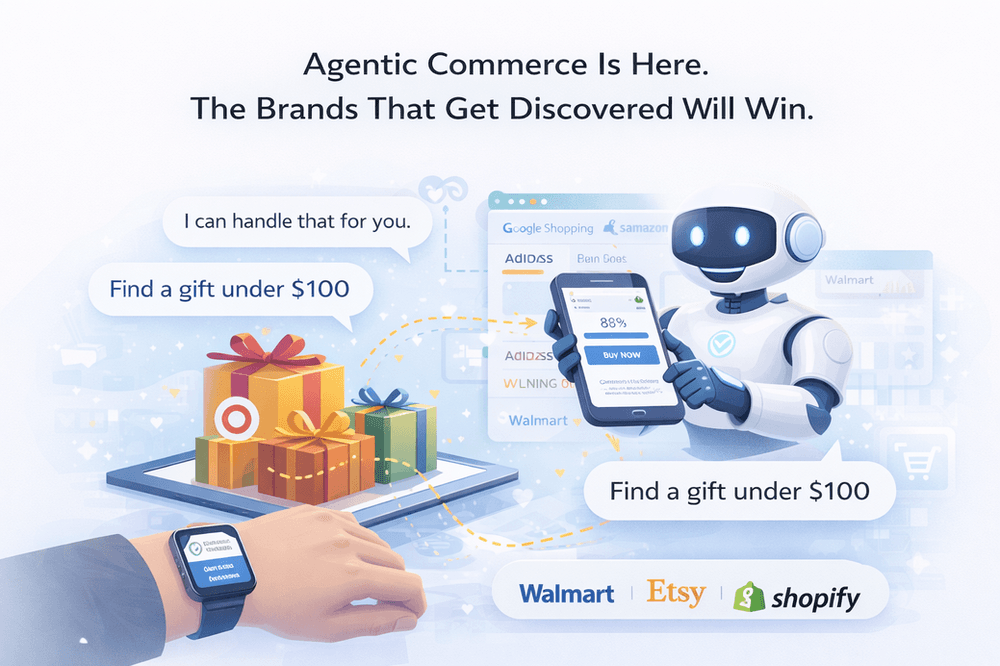
AI shopping is becoming a discovery layer between a customer's question and a merchant's storefront. A shopper can describe a need, refine constraints, compare products, and sometimes begin or complete a purchase without following a conventional search-results path.
The important change for brands is not that every transaction will happen inside a chat. It is that an AI system can influence the shortlist before the shopper visits a product page.
What agentic commerce means
Agentic commerce describes systems that can assist with multiple parts of a shopping journey: discovering products, comparing attributes, checking availability, and facilitating a transaction. The exact handoff varies by platform and merchant.
OpenAI introduced Instant Checkout and the Agentic Commerce Protocol in 2025. In March 2026, it expanded the protocol's emphasis on richer product discovery, including merchant feeds and integrations that can route a shopper to the merchant's own store. OpenAI's current shopping documentation also notes that Instant Checkout may remain available for some eligible products and merchants.
The direction is therefore broader than a single checkout interface. AI systems are being connected to catalog data and public product information so they can help shoppers decide what fits their needs.
Discovery happens before conversion
A shopper might ask for a waterproof daypack under a specific budget, suitable for a laptop and airline travel. The answer engine can translate that request into constraints, compare candidates, summarize trade-offs, and present a small group of options.
By the time the shopper clicks through, several decisions may already have been made:
- Which brands were considered
- Which product attributes mattered
- Which claims were repeated
- Which reviews or sources shaped the comparison
- Which products were excluded because information was missing or inconsistent
That makes accurate discovery data part of conversion strategy. A strong storefront cannot convert a shopper who never sees the product.
What gives a product a fair chance to appear
There is no universal formula for inclusion, and platforms can change their systems. The practical foundation is consistent, verifiable product information.
Complete catalog data
Maintain current titles, descriptions, identifiers, prices, availability, images, variants, shipping details, and return policies. Keep merchant feeds, structured data, and visible product pages aligned.
Content that answers comparison questions
Explain compatibility, dimensions, materials, use cases, limitations, and meaningful differences between variants. Avoid relying on slogans when a shopper needs evidence.
Crawlable product and policy pages
Important details should be available in rendered, indexable pages rather than only inside interactions that a crawler cannot reach. Canonicals, sitemaps, internal links, and supported product markup still matter.
Independent evidence
Answer engines may also use reviews, publications, marketplaces, and community sources. Legitimate third-party coverage can confirm or challenge merchant-owned claims. Brands should monitor those sources for recurring gaps and inaccuracies rather than attempting to manufacture endorsements.
How to measure AI product discovery
Use a stable set of questions based on actual customer needs. Run them across the answer engines relevant to the category and record:
- Whether the brand and product appear
- Whether important details are accurate
- How the product is positioned against alternatives
- Which sources support the answer
- Whether the resulting referral reaches the correct product or variant
Repeat the measurement after catalog, content, feed, or authority improvements. This separates a one-time anecdote from a pattern a team can manage.
The strategic implication
Agentic commerce does not eliminate the merchant experience. It changes how shoppers may arrive and how much context they have before they do. Brands still own product quality, service, fulfillment, and the storefront experience, while AI systems increasingly mediate discovery and comparison.
The most resilient approach is to strengthen both layers: make products easy for answer engines to understand and verify, then deliver a merchant experience that earns the purchase and the customer's trust.
Sentient AEO helps brands measure how they appear across AI-generated answers. To understand where your brand is present, how it is described, and which sources influence the result, contact [email protected].
Sources
- OpenAI, Buy it in ChatGPT: Instant Checkout and the Agentic Commerce Protocol: https://openai.com/index/buy-it-in-chatgpt/
- OpenAI, Powering Product Discovery in ChatGPT: https://openai.com/index/powering-product-discovery-in-chatgpt/
- OpenAI Help Center, Shopping with ChatGPT Search: https://help.openai.com/en/articles/11128490-improved-shopping-results-from-chatgpt-search
- Google Search Central, Introduction to Product structured data: https://developers.google.com/search/docs/appearance/structured-data/product